“I simply believe that what doesn’t kill you makes you… stranger!”
From the movie “The Dark Knight“, C. Nolan, 2008
Table of Contents
Introduction
I am struggling to introduce this article because, to be honest, I don’t really know what to write. Astana was the city where I first encountered Kazakhstan, after a Turkish Airlines flight during which I managed to sleep very little and poorly. Therefore, I don’t know if I was actually aware of what I was visiting, or if my troubled sleep had partially clouded my lucidity, but at first glance, the new Kazakh capital gave me the feeling of being… strange!
It’s a city where Arabesque elements mix with ultra-modern trash, creating a place that is difficult to categorize. After all, it is a city whose current layout is younger than me (and I am very young!), and perhaps for this reason, it gives the impression of not having had time to metabolize the changes that have characterized it since its birth and to realize what it wants to be. In some ways, it seems like an ultra-modern metropolis, but at the same time, walking through the city center conveys a certain sense of desolation (but never insecurity). Astana is a city that springs up out of nowhere in the middle of the steppe desert. From this point of view, it is somewhat reminiscent of Las Vegas, although it is much larger and less chaotic than the latter.
Astana became the capital of Kazakhstan in 1997, replacing Almaty. Its name means ‘capital’, demonstrating the fact that the Kazakhs’ imagination is unparalleled. In 2019, its name was changed to Nur-Sultan, after Sultan Nursultan Nazarbayev, only to revert back to Astana in 2022. This seemingly useless piece of information may actually come in handy if you need to book a flight to or from Astana. In fact, if you type “Astana” into some search engines, you will not find anything. In that case, type in ‘Nursultan’ and Astana Airport (NZQ) will magically appear. I speak from experience, having booked my international flights through Marketplace (to take advantage of company benefits).
After reading this article, you will find out whether, in my opinion, this city is worth visiting, and perhaps even I, by selecting the photos to show, will discover whether I liked it or not.
Itinerary in pills
⭐ Fun scale: 7/10
🏛️ Not to miss: Sultan Hazrat Mosque, Grand Mosque, Bayterek Tower
👣 Mood: City and culture 100%
💰 Free or negligible
💡 Keep in mind: If you arrive in Astana on an international flight, you’ll be given a physical SIM card with 1 GB of data at passport control. Once you’ve cleared immigration, you can easily buy more SIM cards inside the airport.
🎟️ Tip: Book taxis by Yandex, it’s easy and cheap.
The main reason I decided to visit Kazakhstan is linked to the Mangystau region, which is located on the opposite side of the country from Astana. However, to get to Aktau, the starting point for tours of Mangystau, it is generally convenient to take a domestic flight from Almaty or Astana, the main airports for international flights (you can also fly to Aktau on international flights, but the choice is much more limited). Since I would have had to be in one of the two capitals of the country on both my outward and return journeys, I chose to land in Astana and depart from Almaty, so that I could visit both cities (and the surrounding areas, in the case of Almaty) at no extra cost. This is to say that I was not particularly keen to visit Astana, having read less than enthusiastic descriptions from my fellow bloggers.
However, having finally decided to go ahead with this experience, I researched what there was to visit in the city center and planned the stages of my trip. Looking at the city map, it is possible to arrange the attractions of interest roughly along a generally straight route that extends from west to east, with the exception of the Grand Mosque, which is located at a point well off the route. The route to follow along the straight line is about 7 miles long, with some areas having more attractions than others. Specifically, the west side is where the Park of Lovers and the Nur Astana Mosque are located, while Independence Square and the Sultan Hazrat Mosque are on the east side. In between are the Bayterek Tower and the Ak Orda Presidential Palace.
I started from the east side for traffic reasons (arriving by taxi, Google Maps suggested I do so when I made my reservation) and walked the entire 11 km of the straight line, then started again from the west side, making a stopover, again by taxi, at the Grand Mosque. You can find a map of the walking route here.
Detailed itinerary
Arrival in Astana
It’s around 7:30 a.m. when I walk through the airplane door and set foot on the ground of the state’s new capital, aware that I will be leaving the city that same evening, when I will board a domestic flight to Aktau.
I only have one day to visit the city and I didn’t sleep much on the plane, but my enthusiasm for the start of this new journey is very high. Of course, I already have a detailed plan on how to optimize my travel, and I have already explained to my shoes that by the end of the day they will be terribly worn out.
At passport control, there is a guy who only speaks Kazakh and perhaps Russian, but thanks to gestures and the fact that Italian citizens do not need an entry visa, I manage to get my document stamped. As a bonus, I also receive a physical SIM card, which I can activate and use free of charge for 24 hours. However, as my trip lasts 12 days, I decide to keep it as a spare and buy another SIM card at the airport, where I find several companies ready to sell me one just after security. On the advice of a local girl, I decide to go with BeeLine.
I exchange some cash at the airport at a very favorable rate (according to the exchange rate shown by Google, I even make a small profit 😊) and leave my larger luggage at the airport storage facility. The ridiculous amount I pay, together with my other experiences a few minutes earlier, makes me think that they are not very used to receiving tourists in those places.
Using the Yandex app, which will prove invaluable in the days to come, I call a taxi that takes me to the city center for 2,500 tenge (equivalent to about €3). The journey takes half an hour, during which the taxi driver tells me lots of things in Kazakh, to which I nod and smile, without understanding a word, of course.
Independence Square
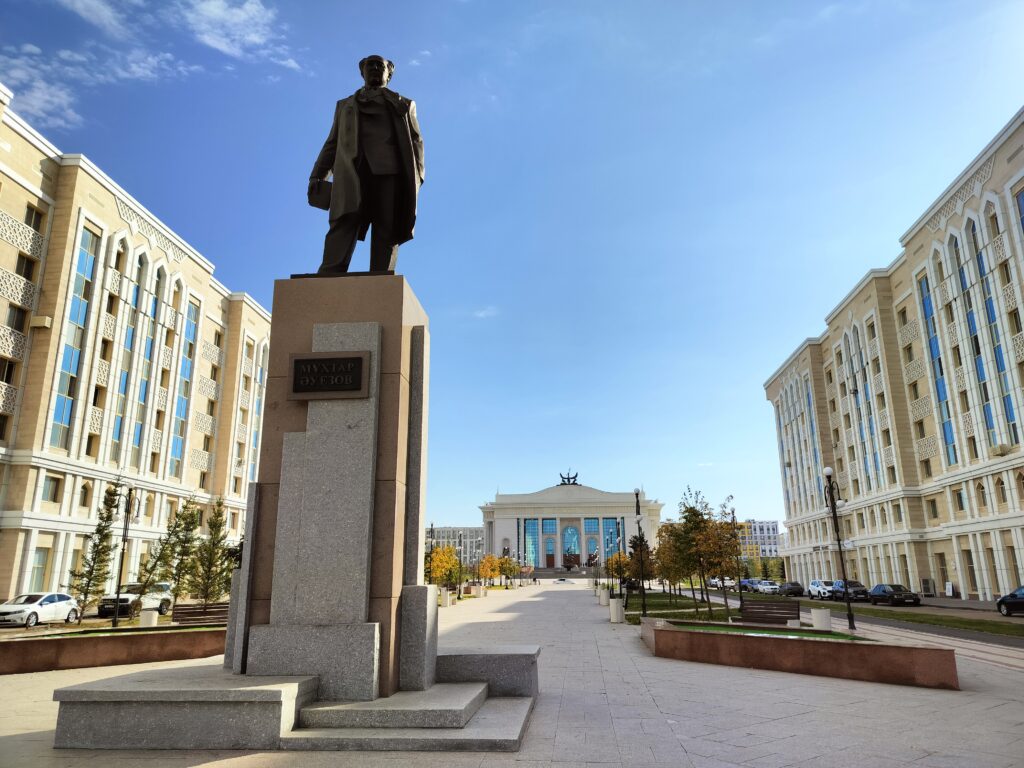
My tour of the city begins at Independence Square, a square where you can find a number of vaguely interesting things:
- The Palace of Independence, built to celebrate Kazakhstan’s independence from the USSR in 1991. Inside the palace, there is a miniature model of the city and a painting by a Russian artist celebrating politicians from around the world who have visited the city since its foundation. As I don’t have much time and don’t feel a strong desire to see the palace from the inside, I decide not to visit, despite the negligible cost (the equivalent of a few cents).
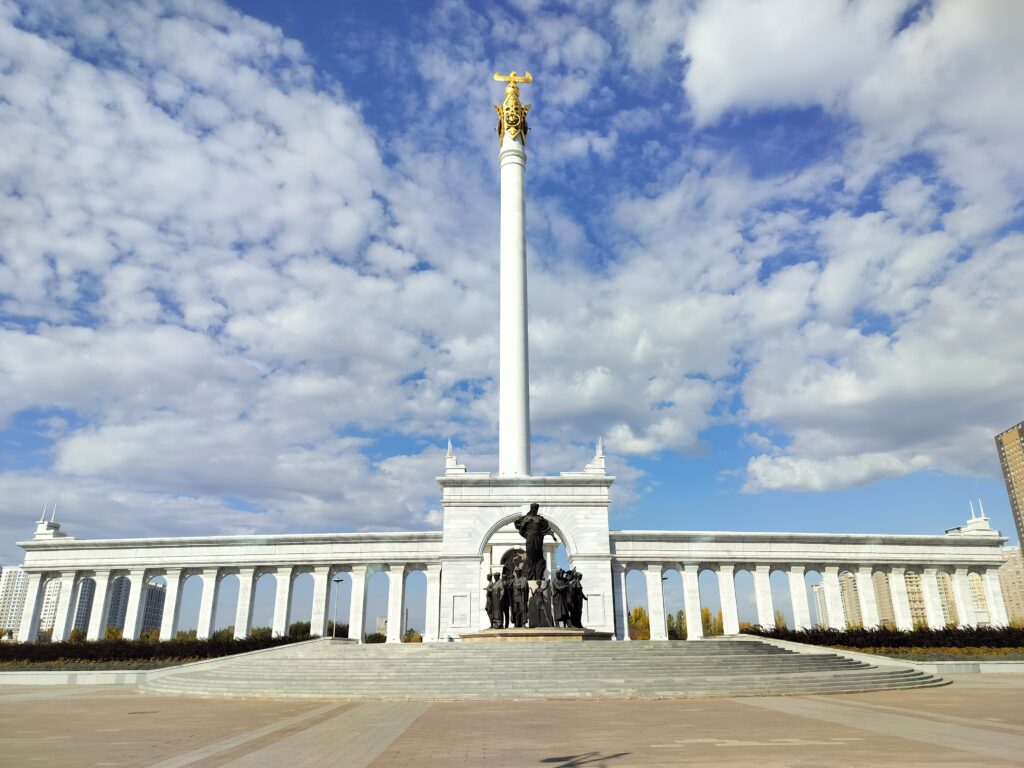
- The Kazak Eli (Land of the Kazakhs) Monument, a 91-meter-high white column (the height is not accidental, as it commemorates 1991) topped with a representation of a sacred bird and decorated with bas-reliefs depicting important events related to independence.
- The Wall of Peace, on which the word ‘peace’ is engraved in 51 different languages, symbolizes Kazakhstan’s commitment to nuclear disarmament.
- The main building of the Kazakh National University of Arts.
- The National Museum of the Republic of Kazakhstan, which I am unable to visit due to lack of time.
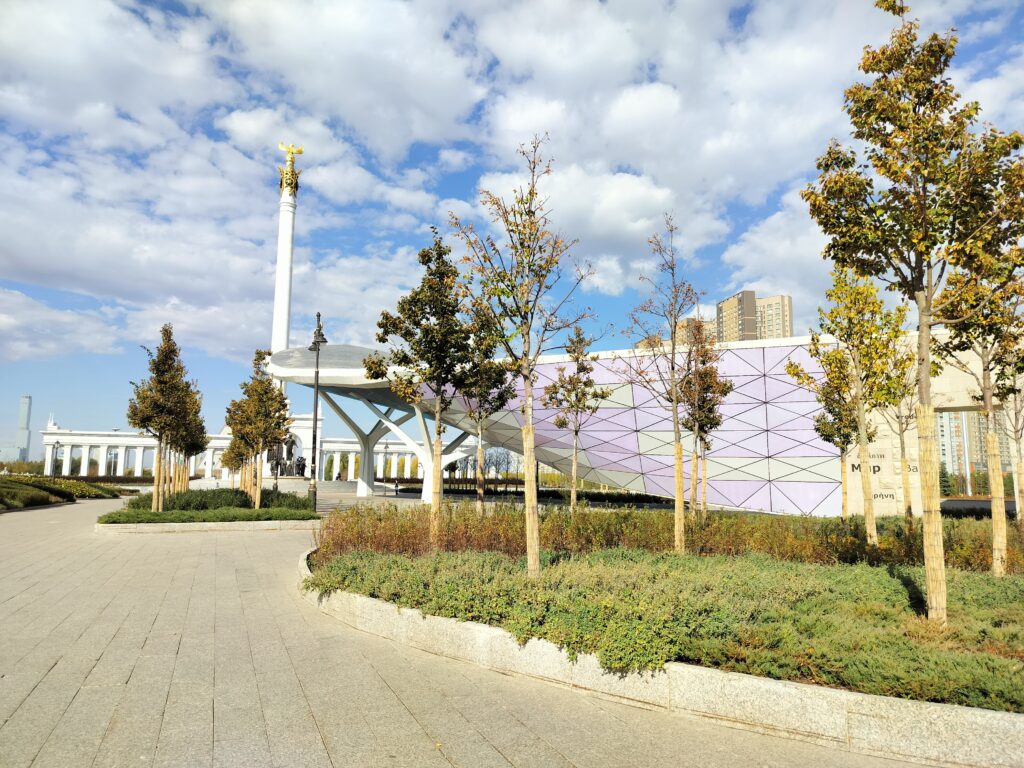
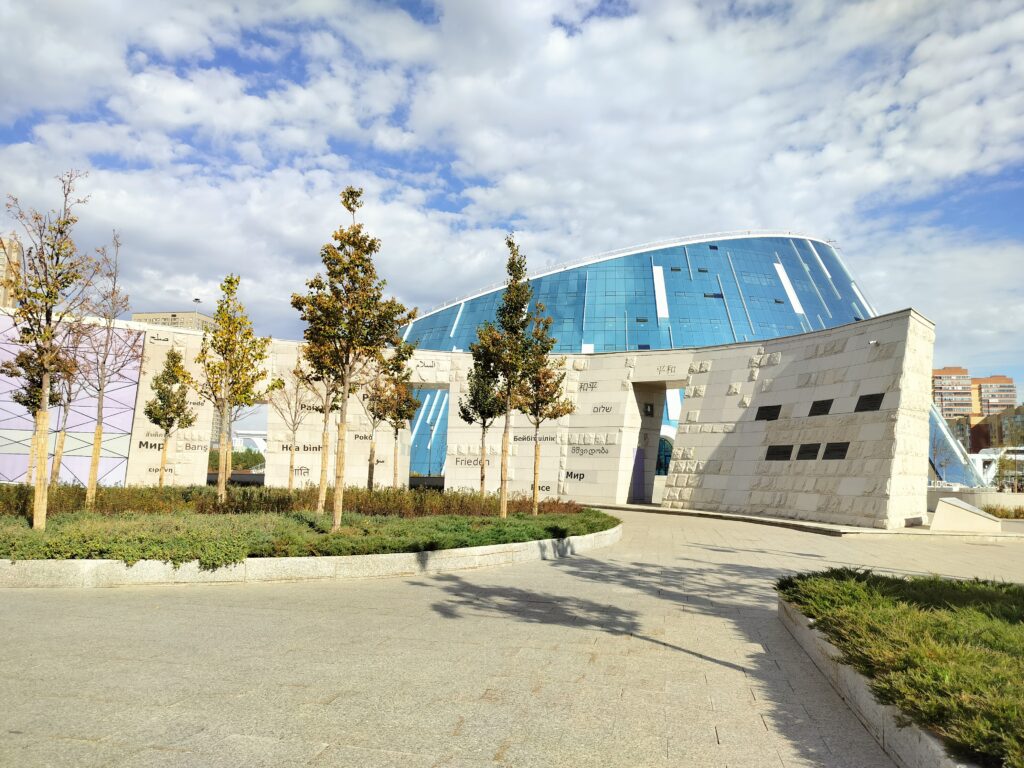
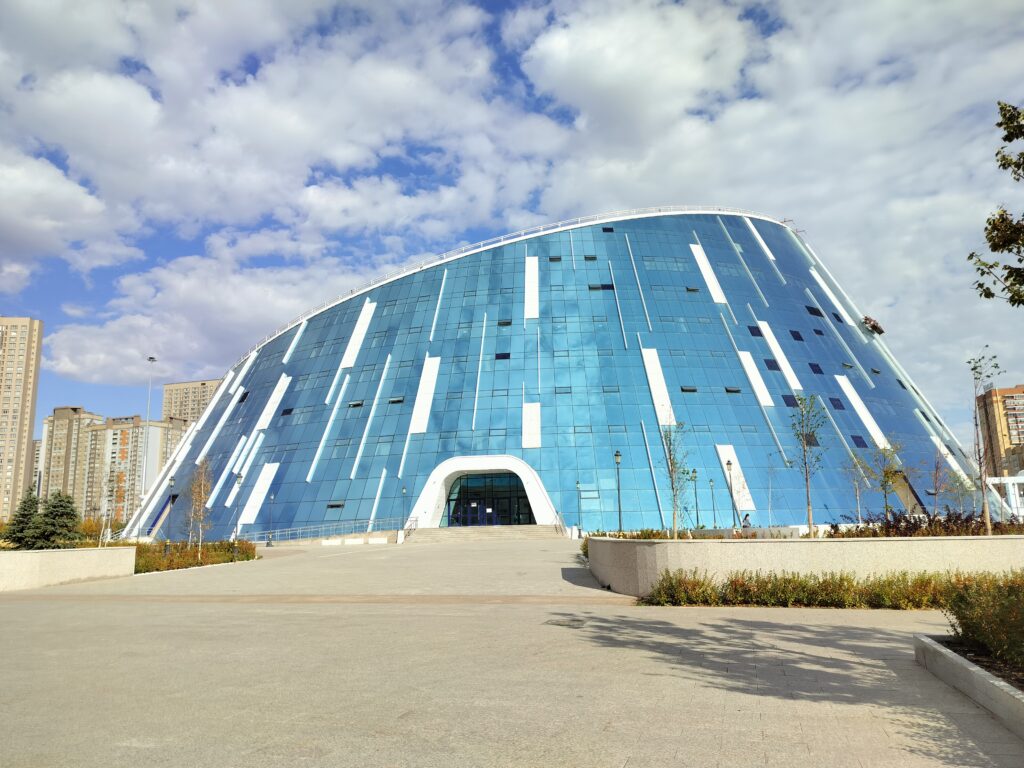
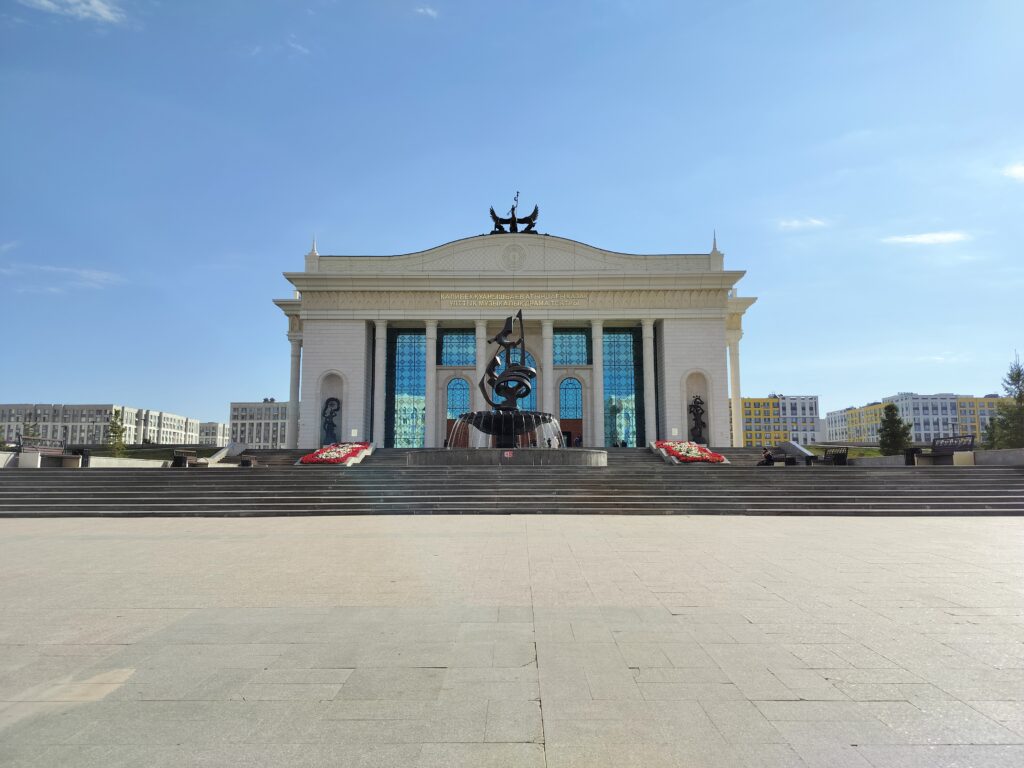
A few steps from the square, there is also the Musical Drama Theater, surrounded by a series of buildings of dubious taste (in the sense that I cannot define them as beautiful, but neither as ugly).
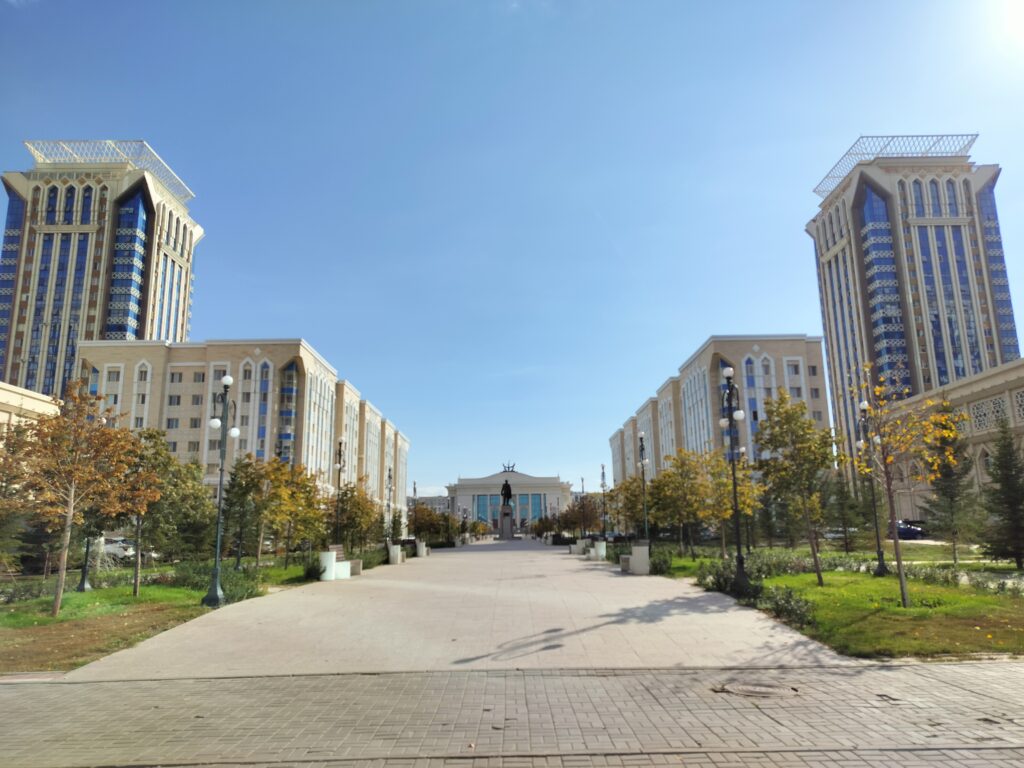
Sultan Hazrat Mosque
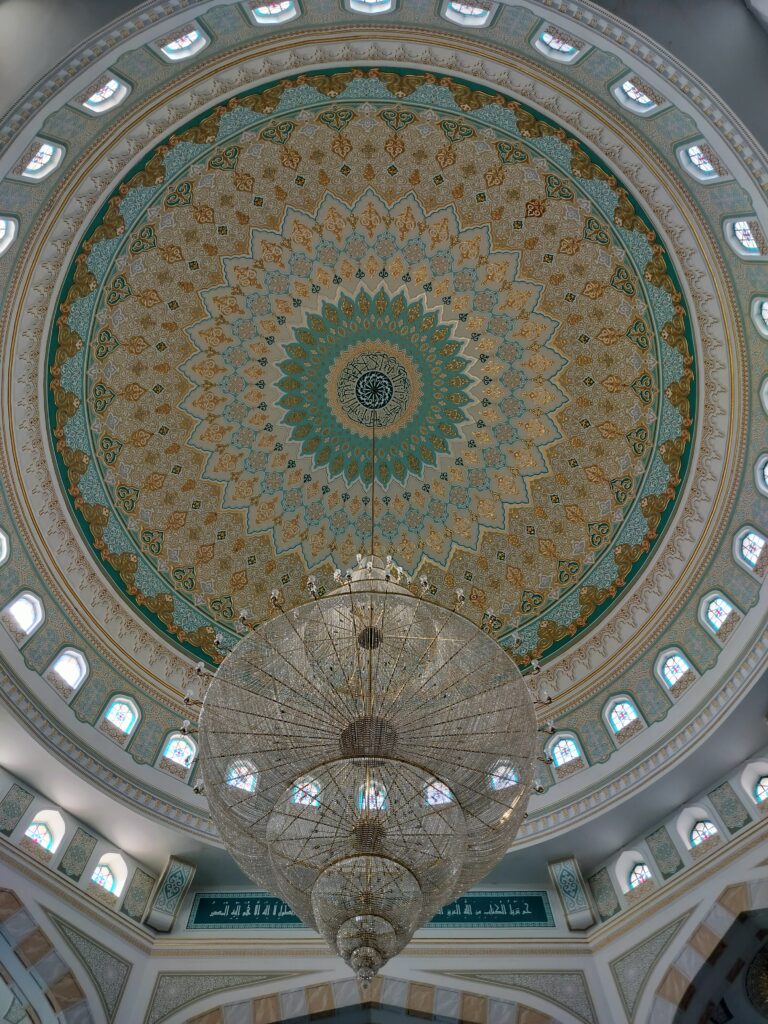
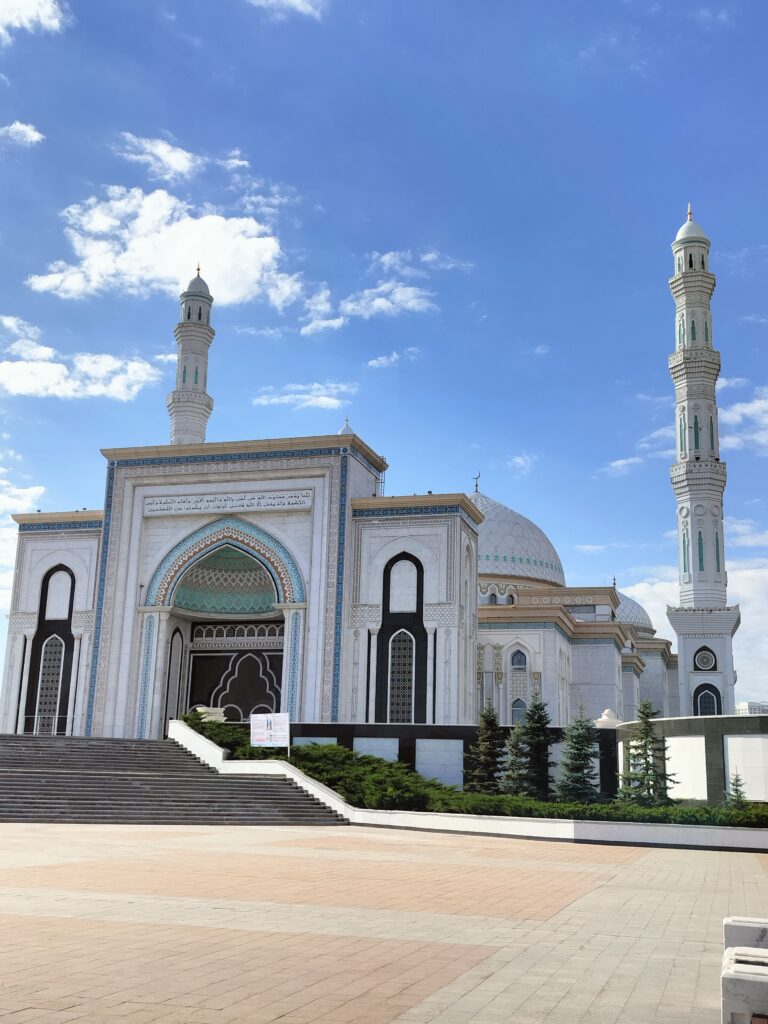
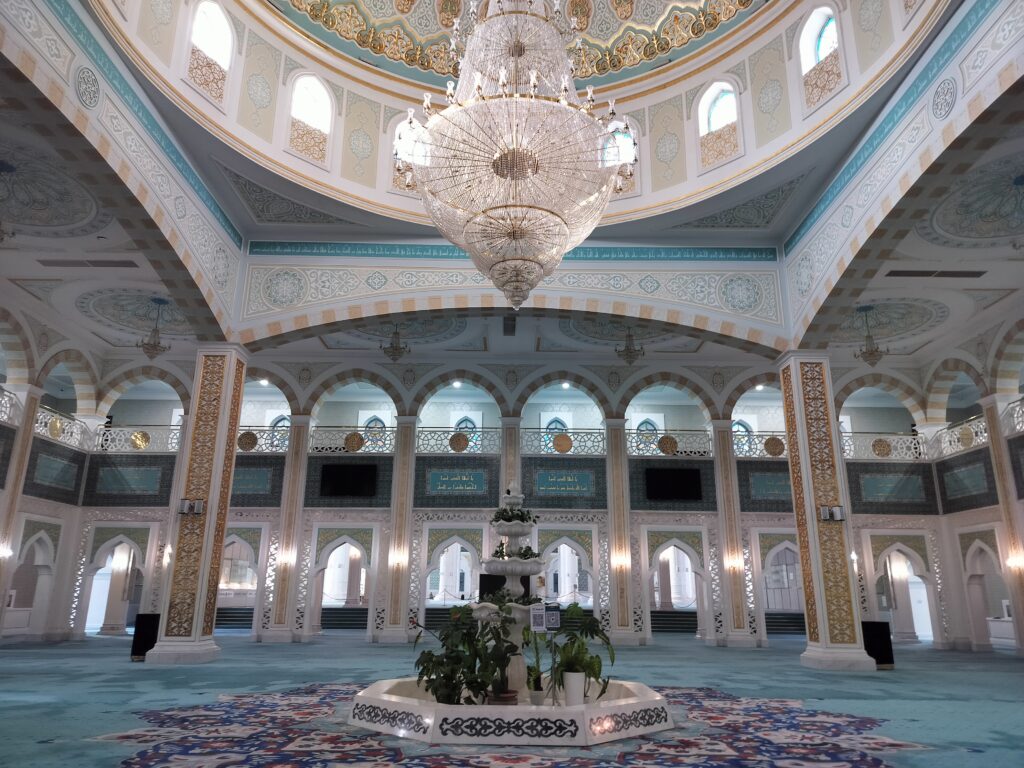
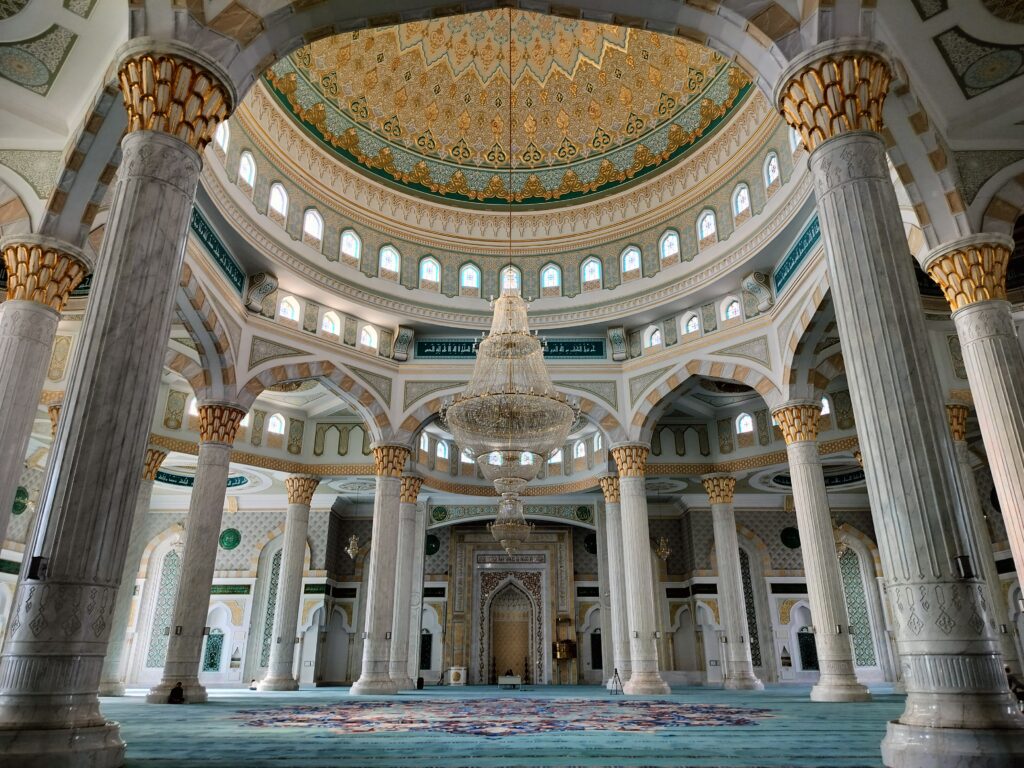
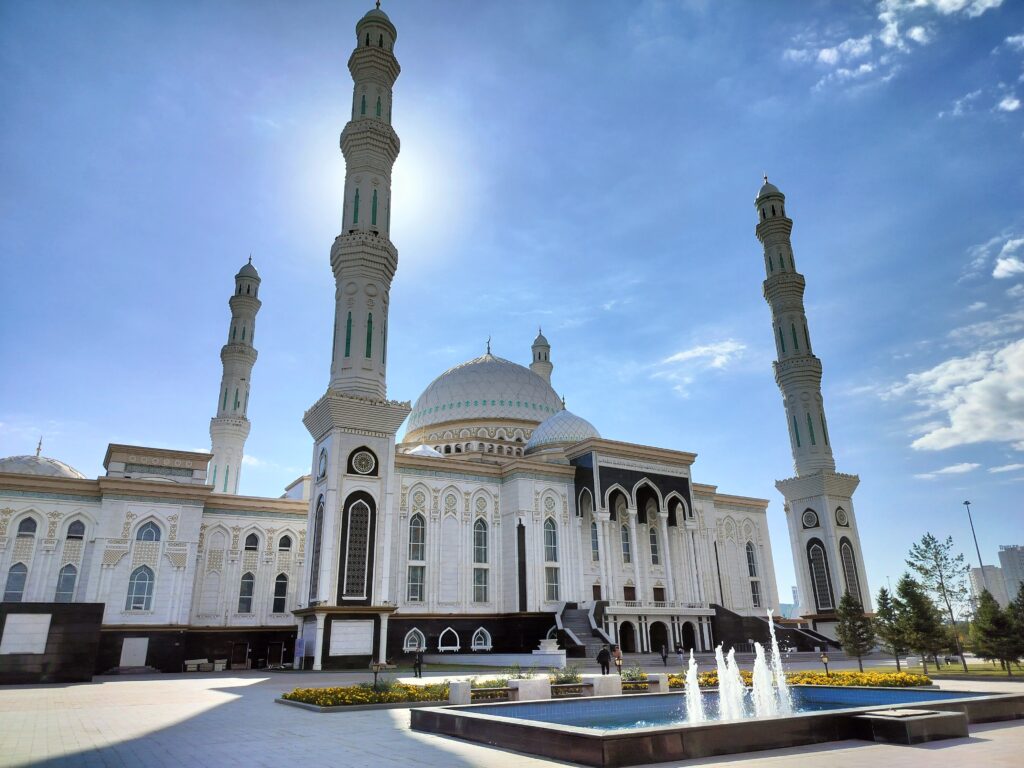
The next stop after Independence Square is the Sultan Hazrat Mosque, which, together with the Grand Mosque, is undoubtedly Astana’s must-see attraction. It was inaugurated in 2012 and is one of the largest mosques in Central Asia. The mosque is beautiful from the outside, but it is also well worth visiting inside, where the decorations are stunning and in typical Kazakh style.
Presidential Park
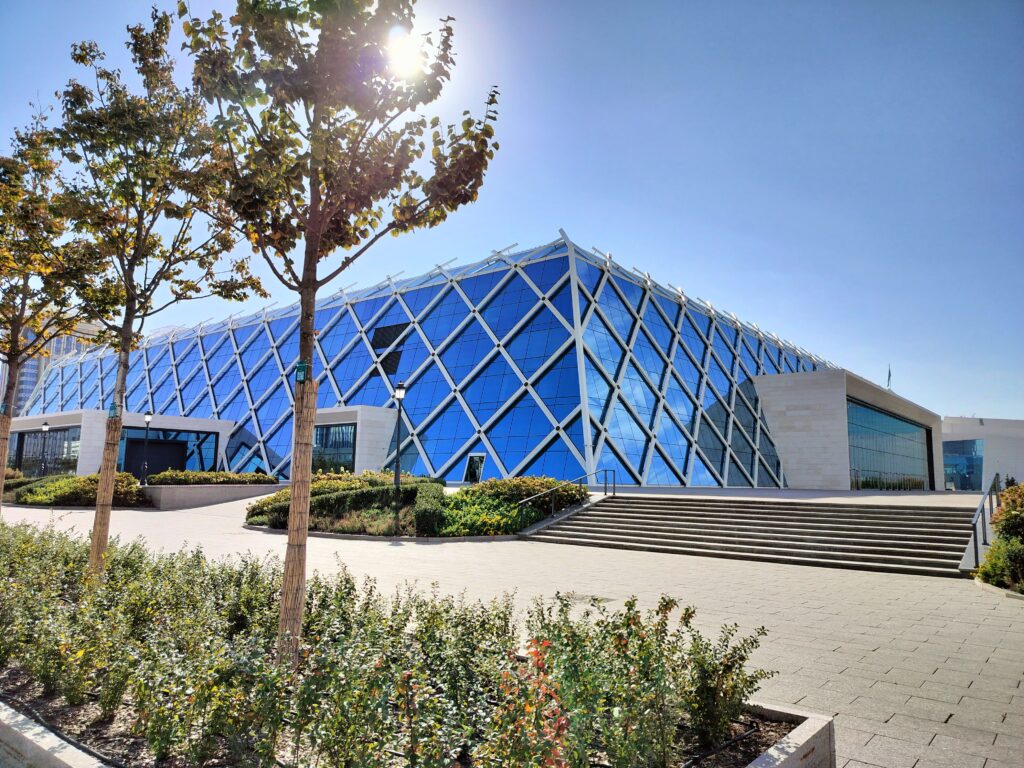
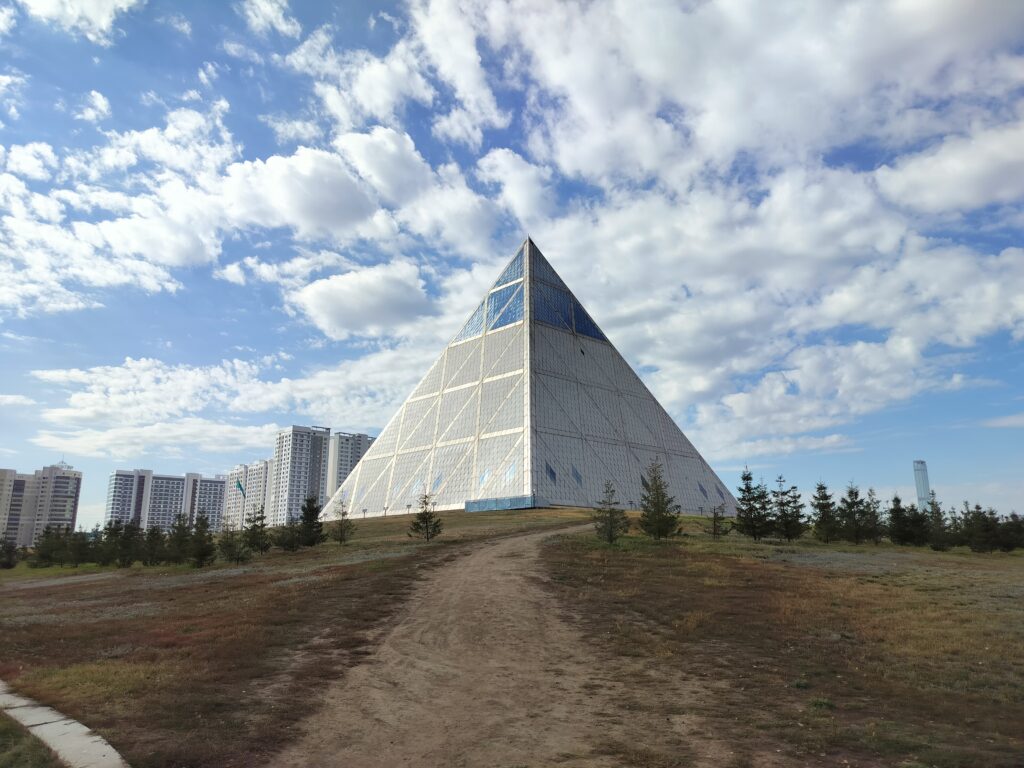
After visiting the Sultan Hazrat Mosque, it’s time to head to the western part of the city. The first attraction I come across as I cross the Presidential Park is the Pyramid of Peace and Reconciliation, a pyramid-shaped building constructed in 2006 out of steel, glass, and concrete, and one of the symbols of the city. Inside, there are several other things, including an opera house, the University of Civilization, and the Museum of History of Kazakhstan, as well as conference rooms and a library.
For one of Astana’s most famous attractions, I must say that I honestly expected something more. From the hill on which the pyramid is built, you have a decent view of the city center and the Presidential Palace, but nothing to write home about.
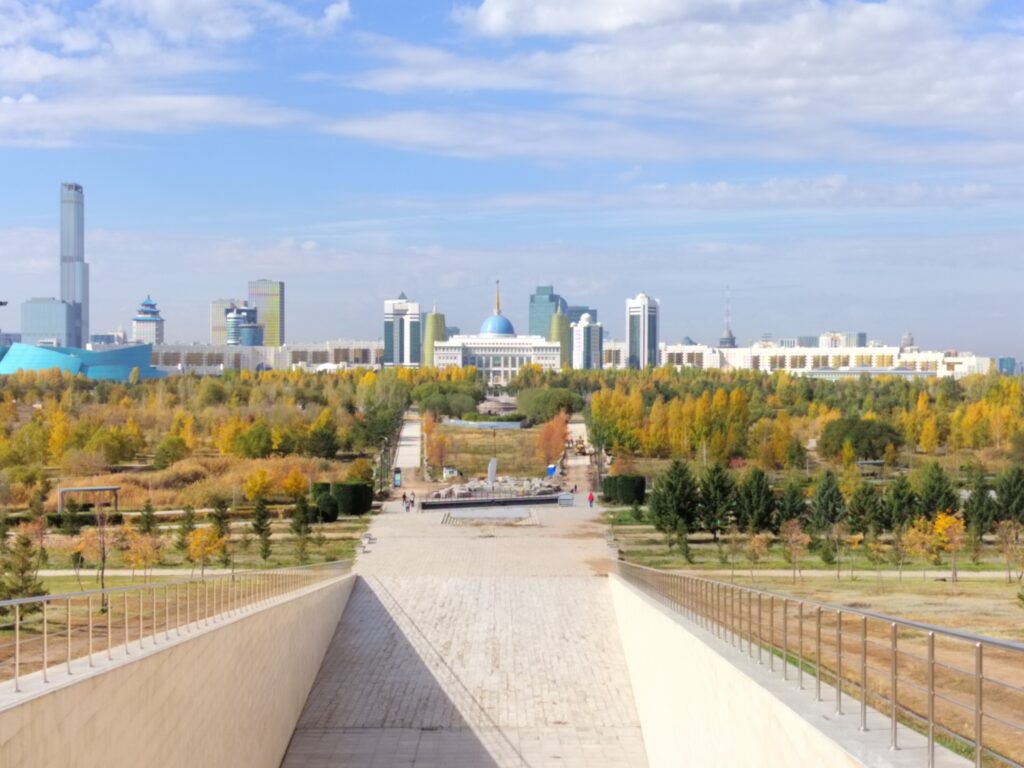
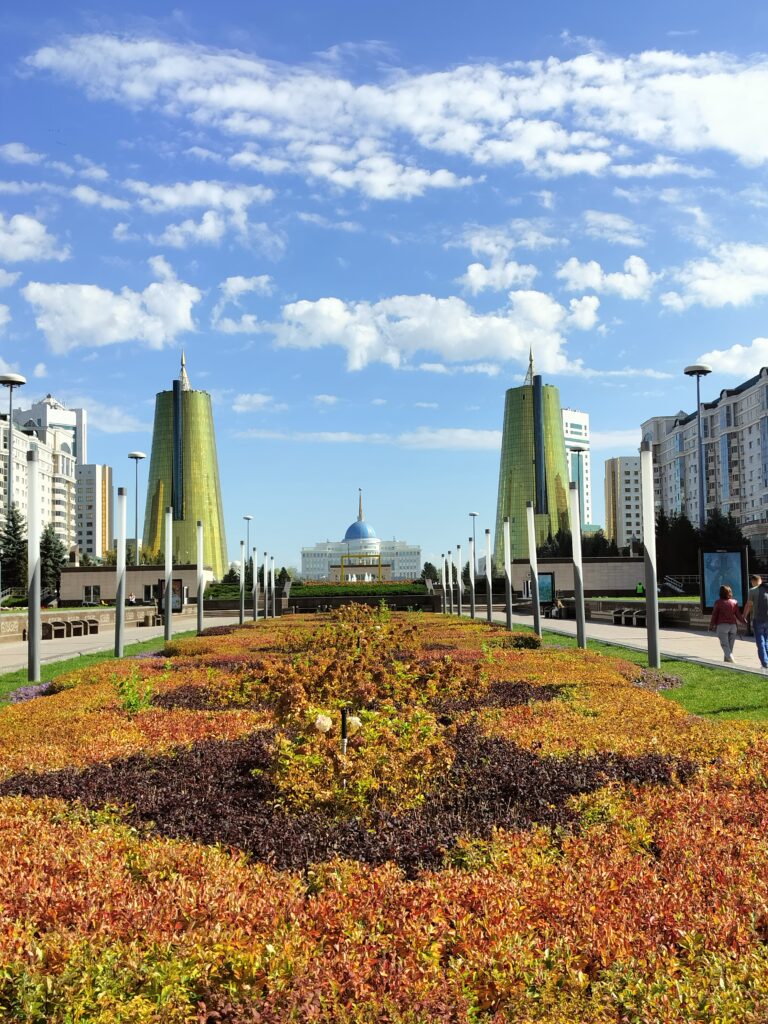
After passing the pyramid, I continue my long walk towards the Ak Orda (white horde) Presidential Palace, home of the President of the Republic of Kazakhstan. The building dates back to 2004 and stands out for its blue dome, topped by a long golden spire, culminating in a sun and an eagle, also in gold. The spire makes the building the tallest presidential palace in the world. I manage to clumsily enter the Presidential Park, where, as often happens on my travels, there is construction work in progress. For this reason, I am forced to take a longer route, which, all things considered, I don’t mind, as it gives me the chance to see some interesting sights.
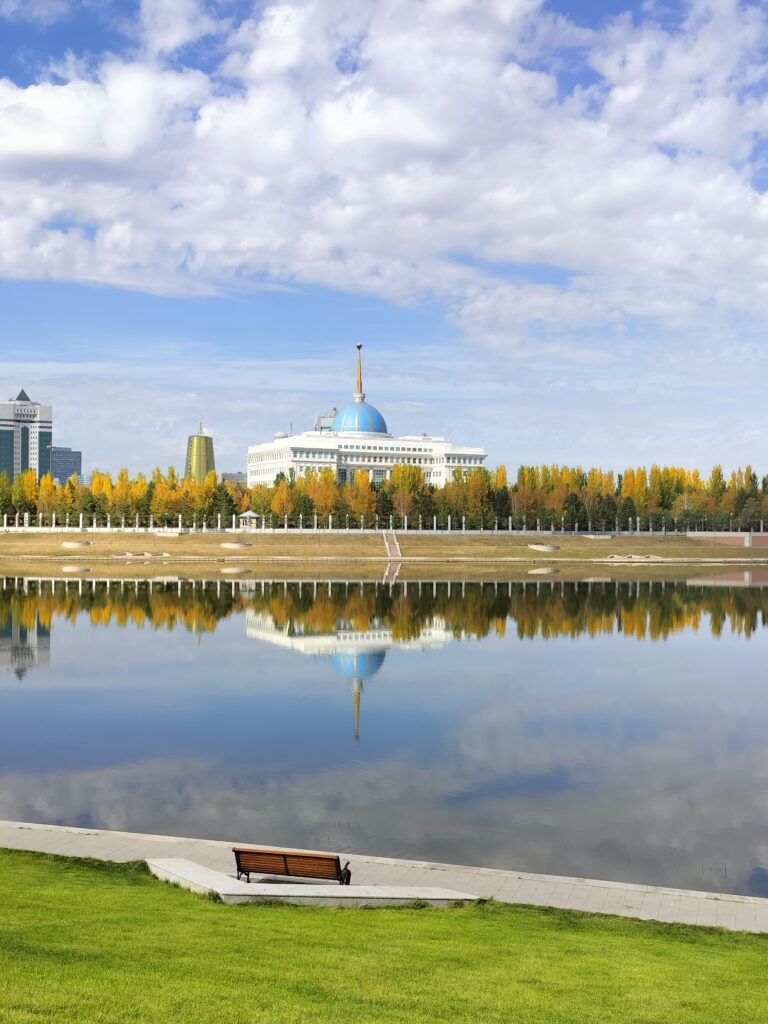
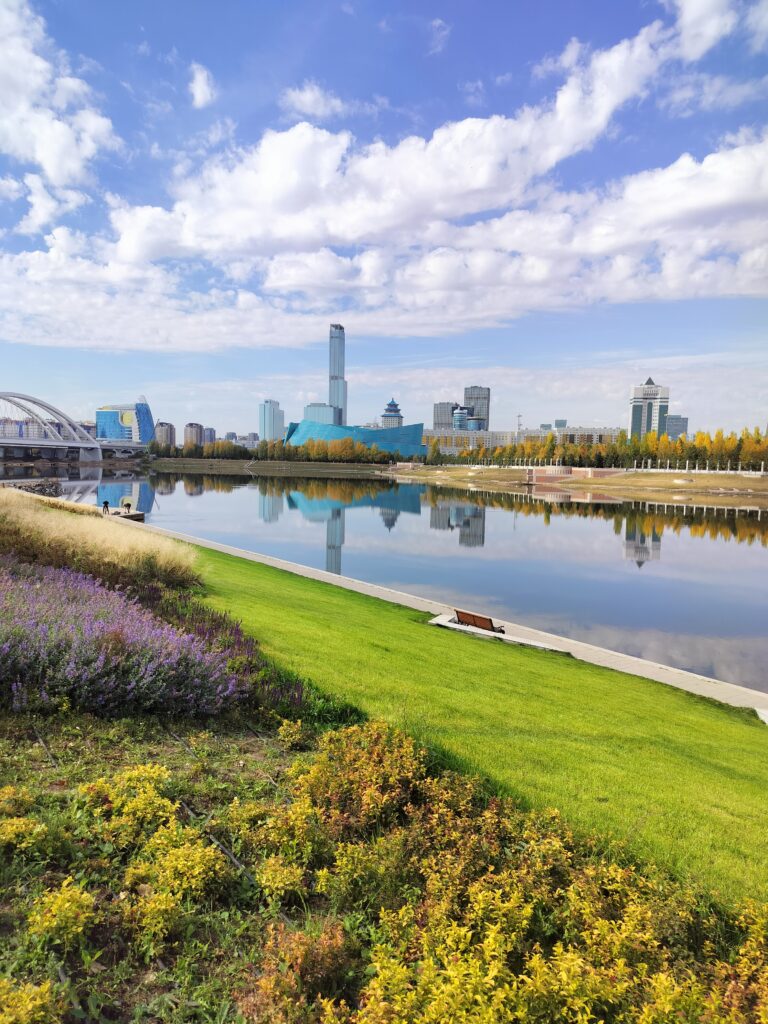
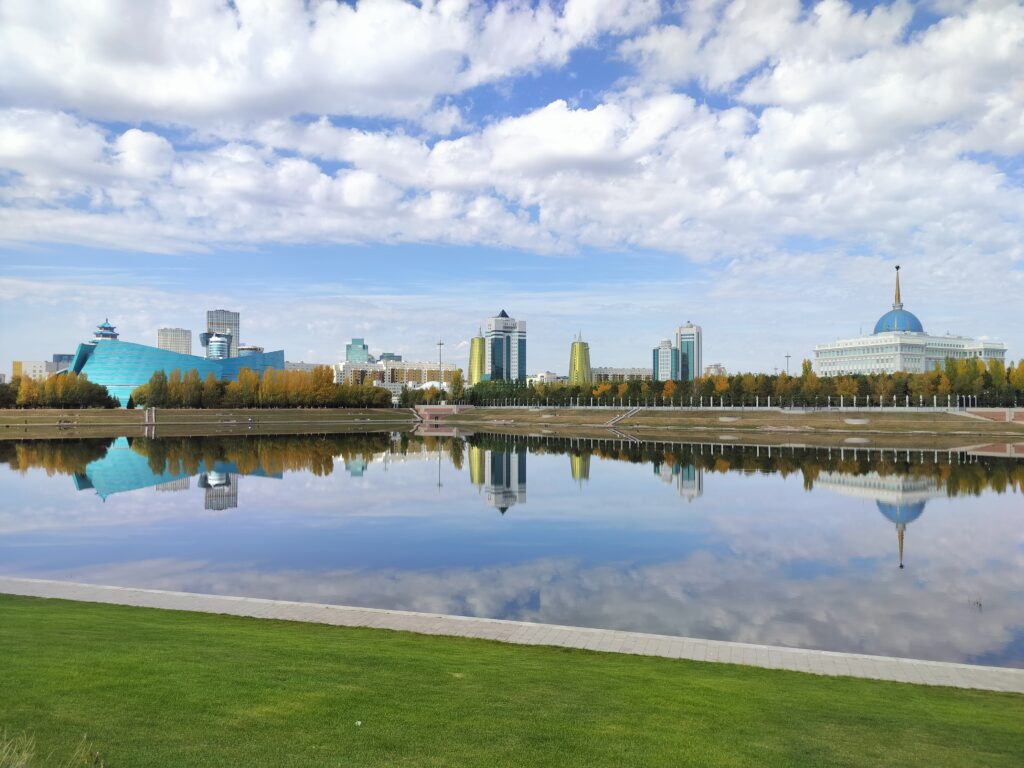
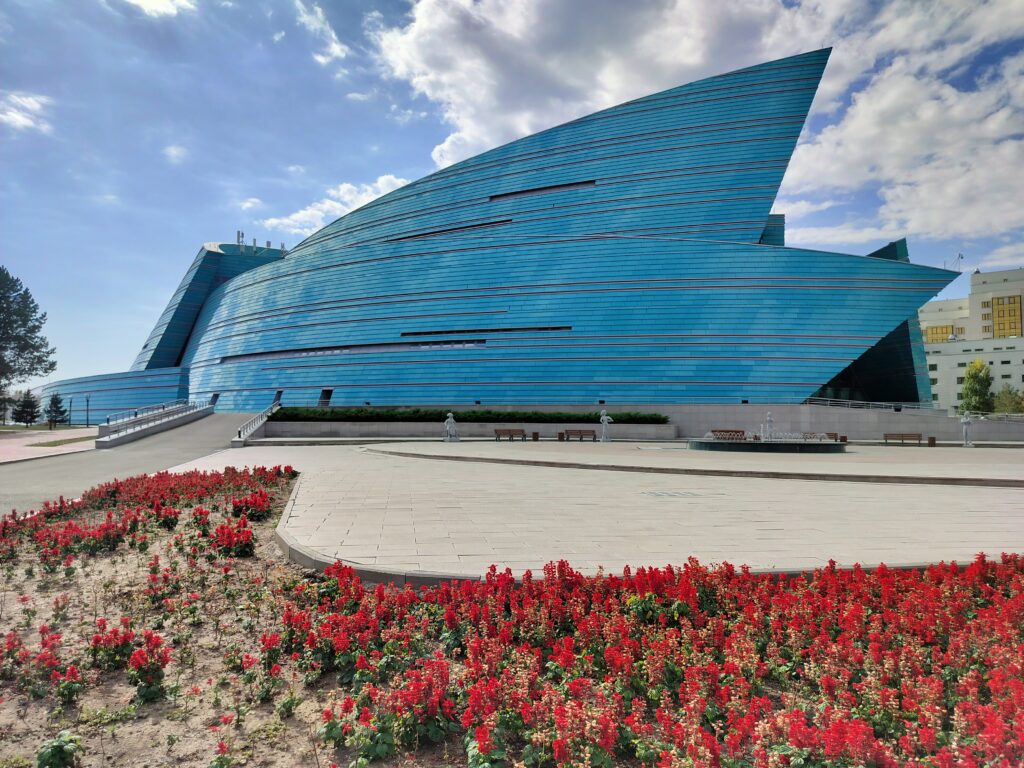
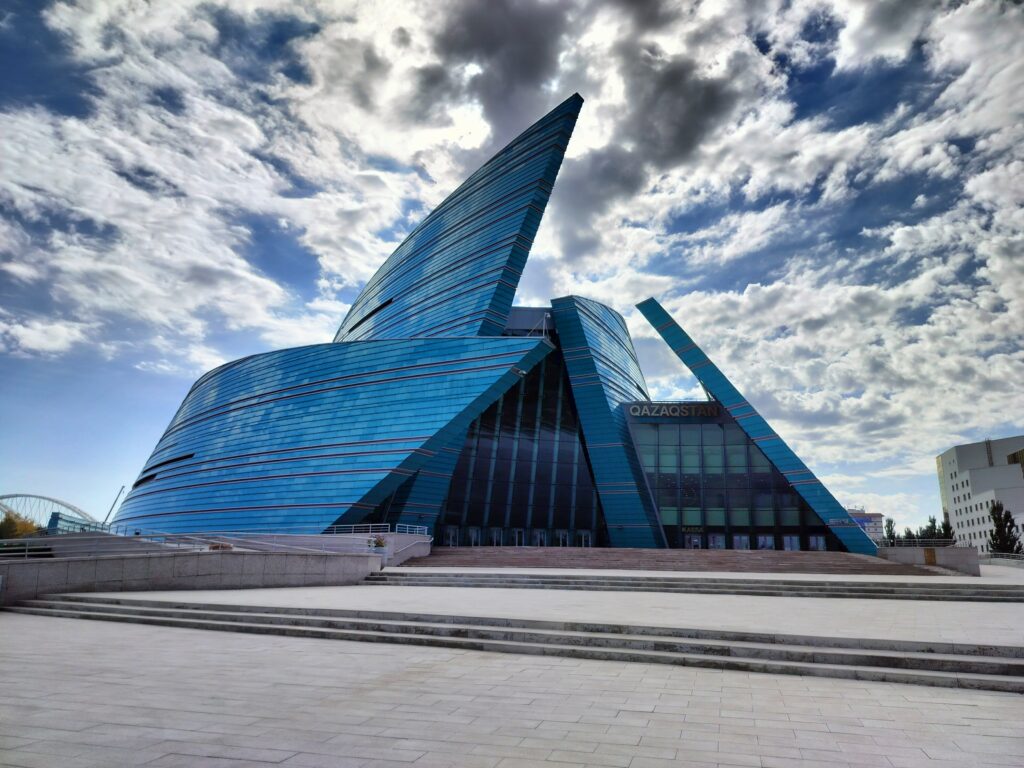
When I arrive at the Concert Hall dedicated to opera singer Roza Baglanova, I finally find a small street that allows me to approach the building. However, as I try to enter, I am called back by a police officer, who explains to me, using an instant translation app, that “that place is like the White House,” so I cannot approach it. At that point, I wanted to tell him that I had seen the White House from its main gate, but I decided not to, to avoid using Google Translate and knowing that it would have been useless anyway.
I take the opportunity to observe the Concert Hall, which is, as usual, an ultra-modern building, but rather cool.
Bayterek Tower
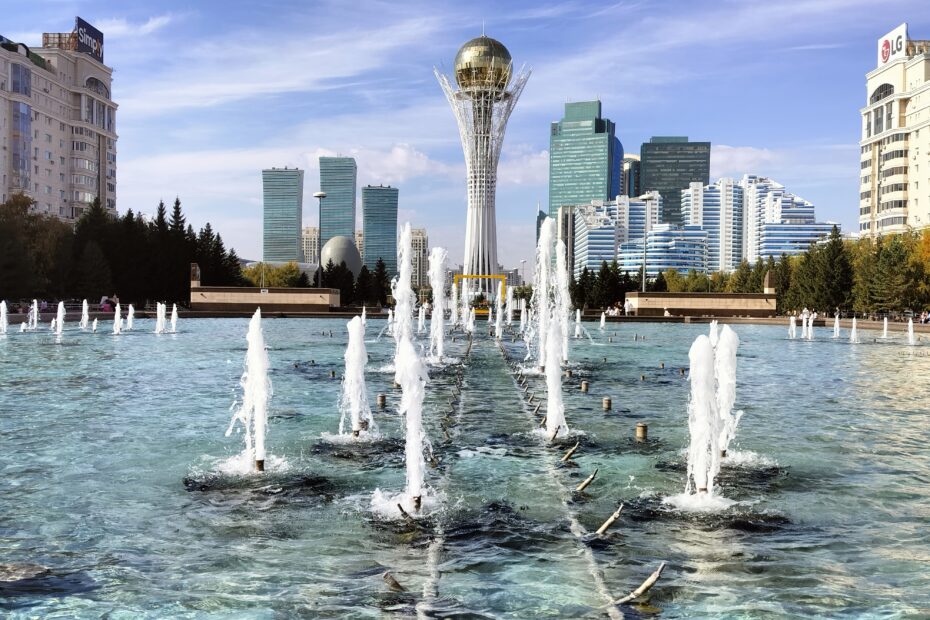
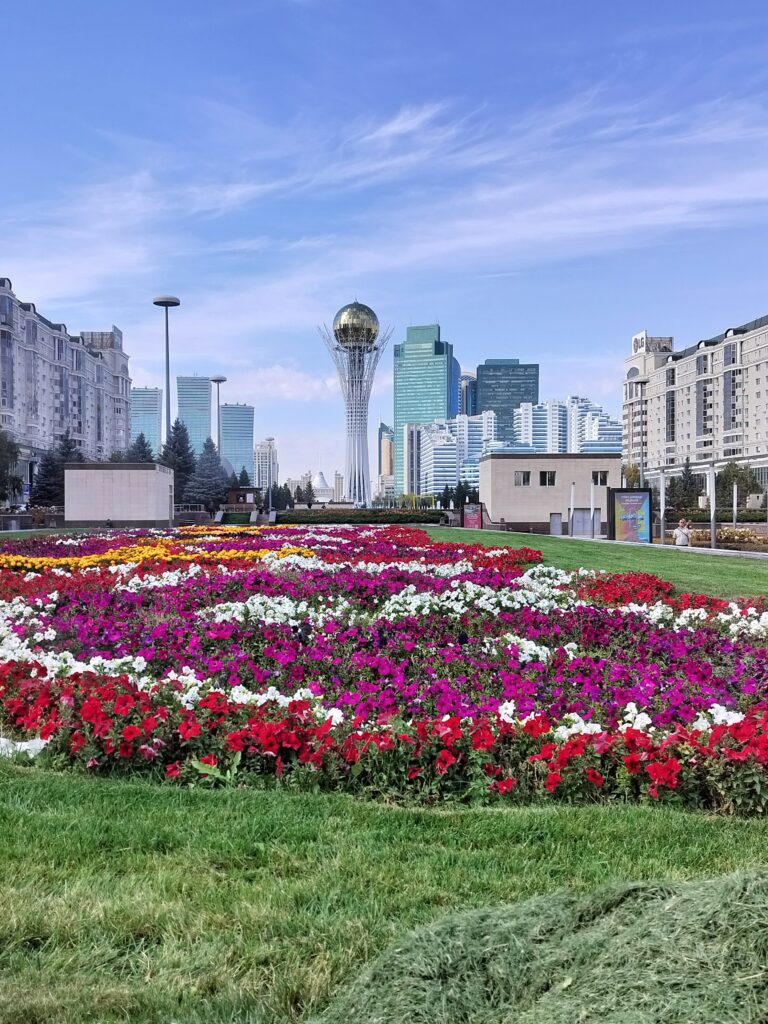
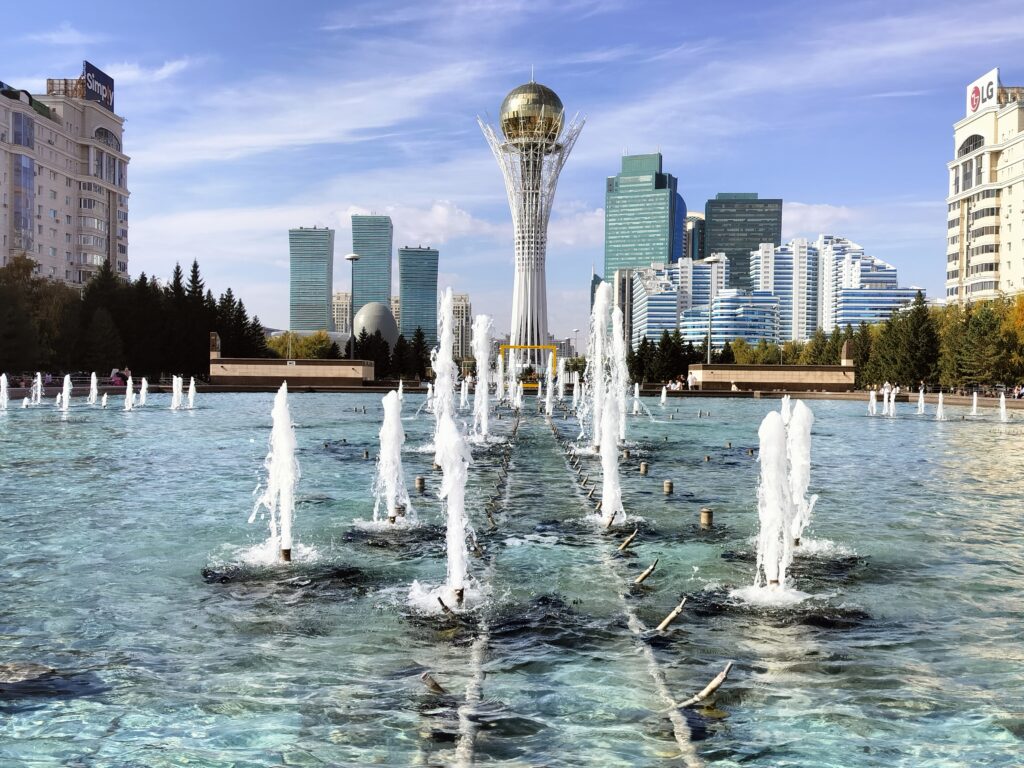
I then continue towards Bayterek Tower, the symbol of the city and by far its most famous attraction. The tower was built in 1997 (and is 97 meters high) to celebrate the relocation of Kazakhstan’s capital from Almaty to Astana. The most important element of the building is the nest at the top, home to the legendary Homa bird, bringer of happiness. The nest encloses a golden sphere, representing the beginning of everything. The Bayterek Tower, as a whole, is a symbol of life. The best view of the tower is from the small park where the so-called Singing Fountain is located, which also offers an excellent view of the Presidential Palace.
Nur Astana Mosque
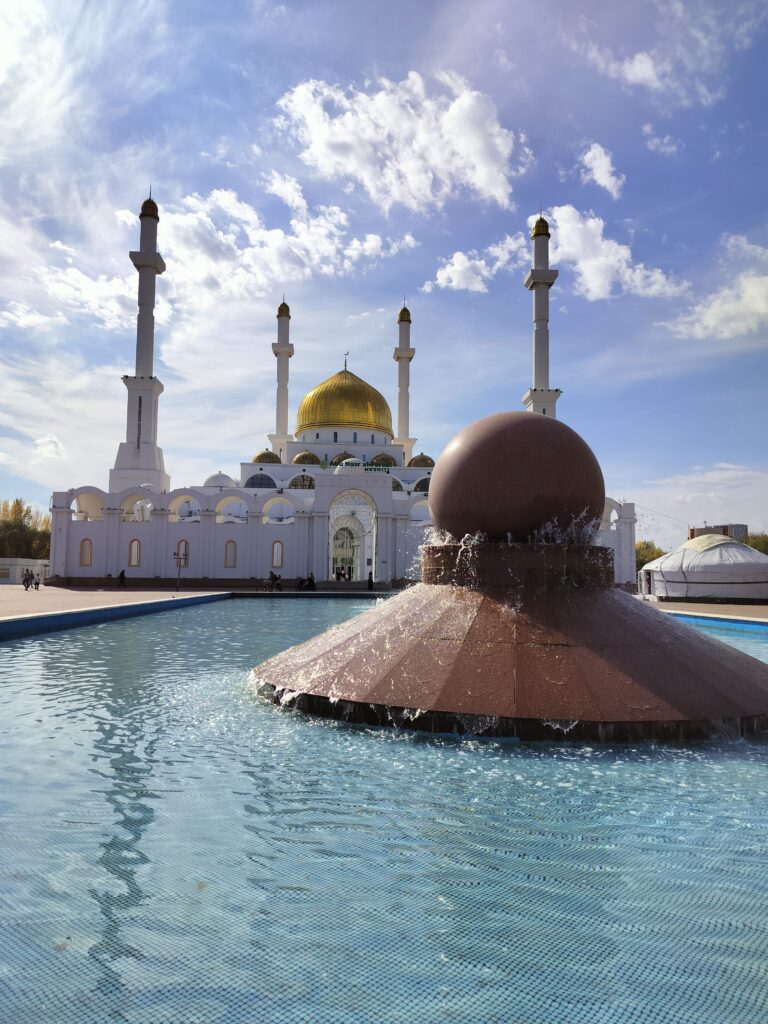
After touring the area around the tower, the Astana tour continues with the Nur Astana Mosque, which, in addition to being one of the largest mosques in Central Asia, represents a gift exchanged between Kazakh President Nazarbayev and Emir of Qatar Bin Khalifa. The mosque was built in 2005. The body of the building is white, while the dome and the tips of the minarets are gold. Here too, some dimensions are symbolic: the height of the mosque and its minarets are exactly 40 and 63 meters, respectively, the age at which Muhammad received the revelation and the age at which he died.
In the photo, the mosque appears, in my opinion, more beautiful than it actually is, certainly not comparable to the other more important mosques in the city. However, it may be worth visiting inside.
Park of Lovers
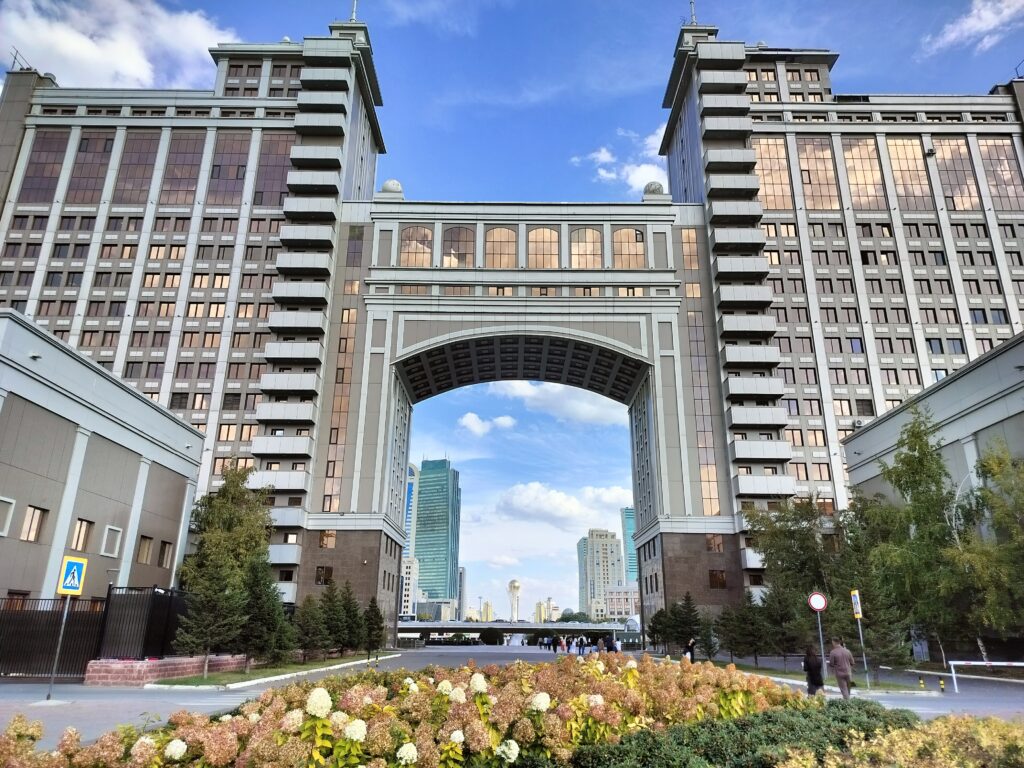
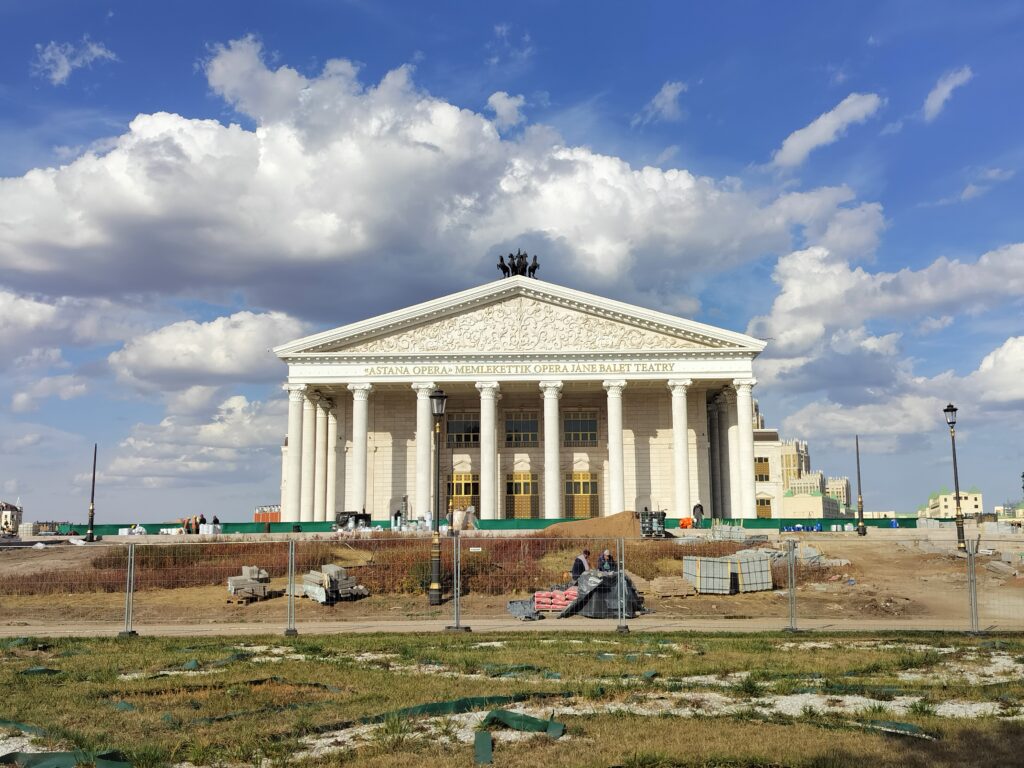
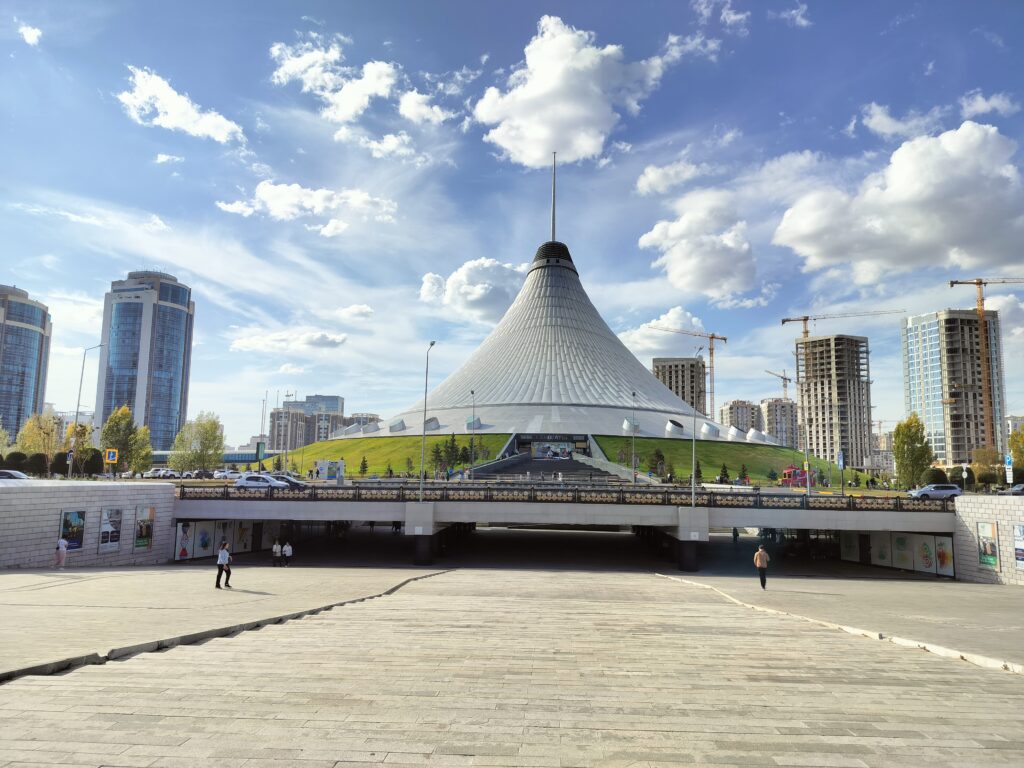
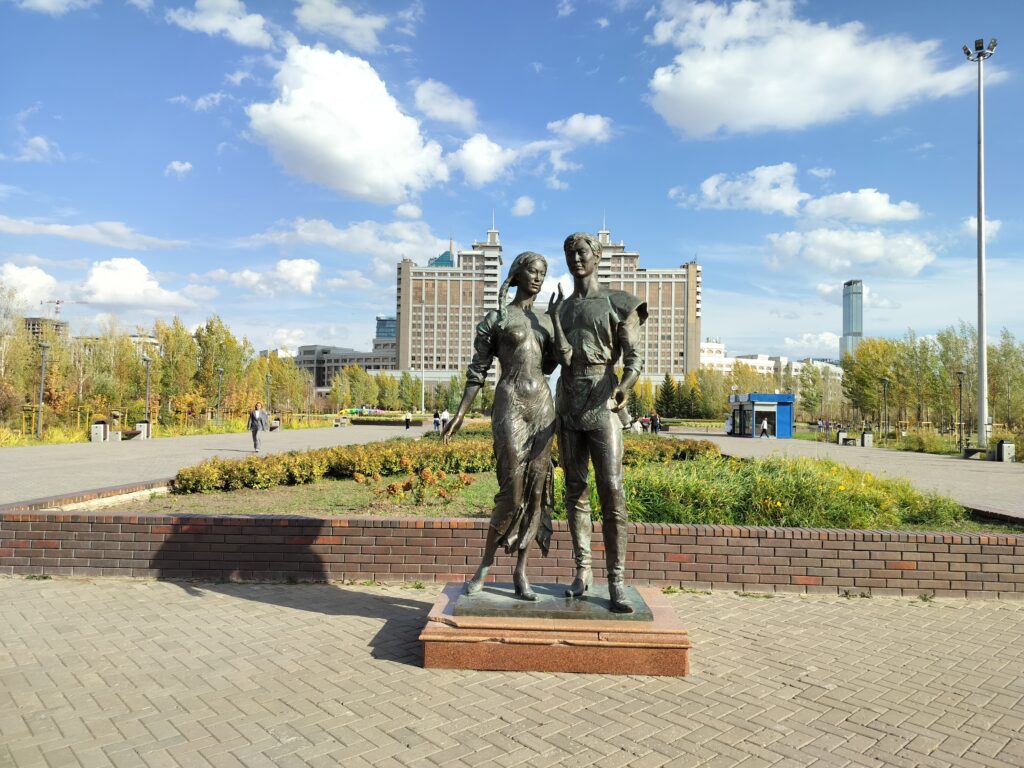
Once outside the mosque, I head towards Lovers’ Park, a fairly large green area inaugurated in 2005 to celebrate Capital City Day. Next to the park are two other well-known attractions in the city. The first is Khan Shatyr, a shopping center shaped like a yurt (a typical Kazakh tent), considered the tallest tent in the world at 150 meters above ground. The second is the State Opera Theater, built in 2013 in neoclassical style. Among the peculiarities of this theater are the theatrical performances in which camels and other animals stand out among the actors. The theater looks nice, but the shopping mall looks like a huge tourist trap.
I say ‘seems’ because I am unable to visit either Khan Shatyr or the theater due to the usual renovation work in progress. Sooner or later, I will be made Minister of Cultural Heritage worldwide, with all the work I find every time I leave home.
Grand Mosque
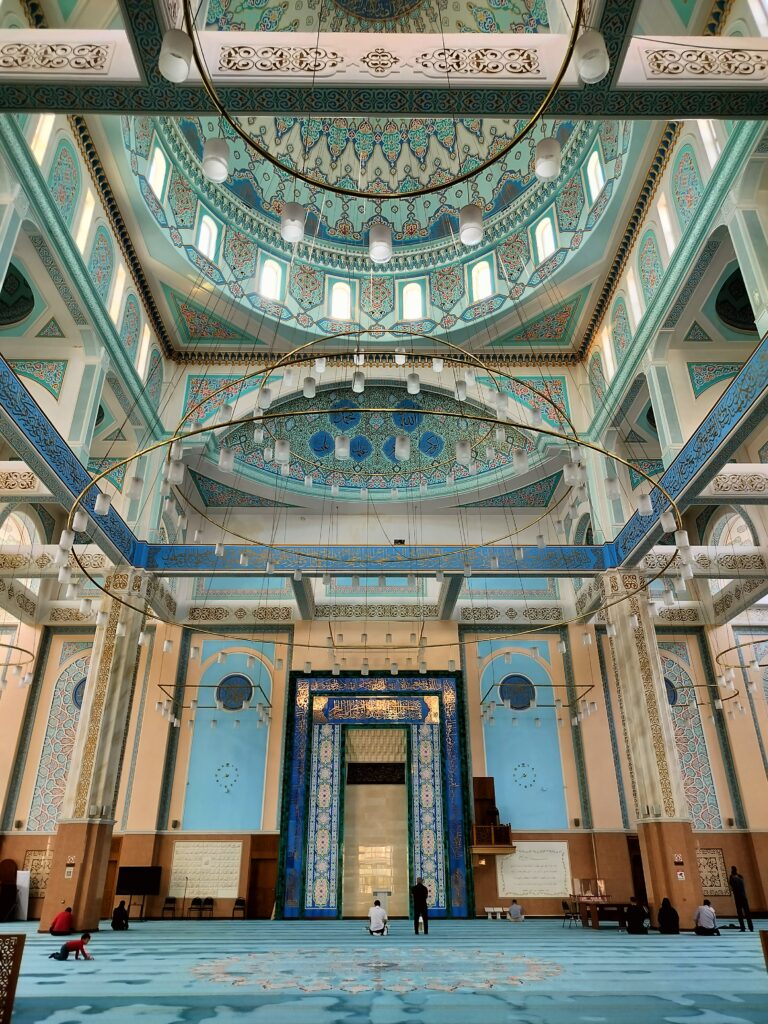
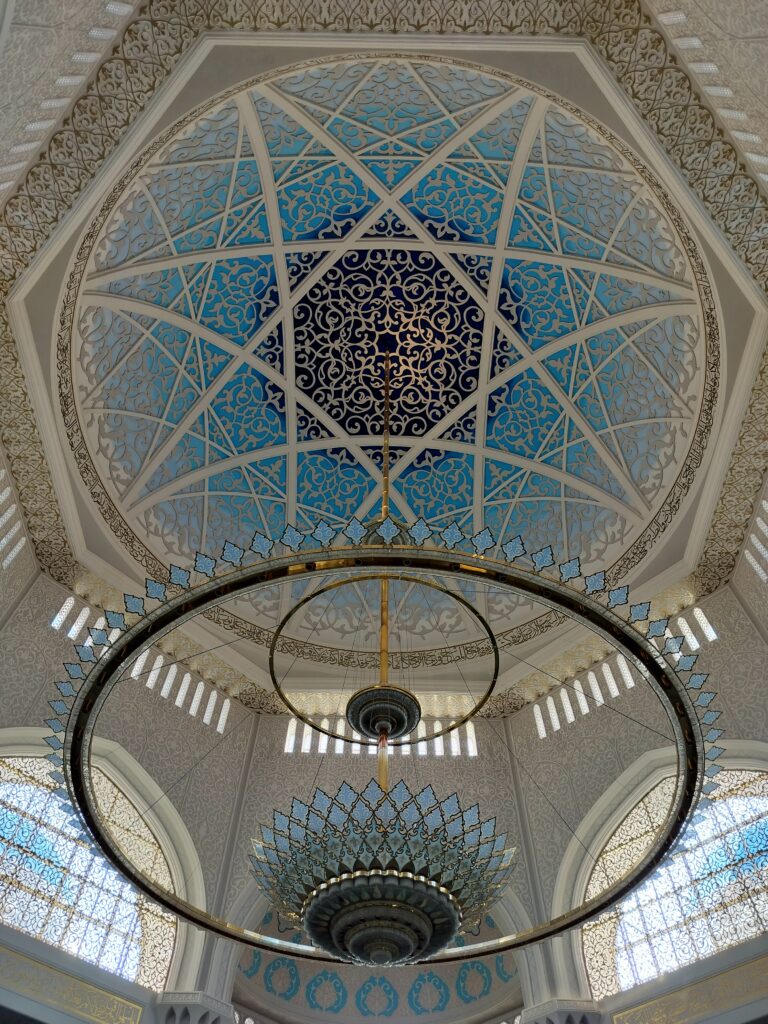
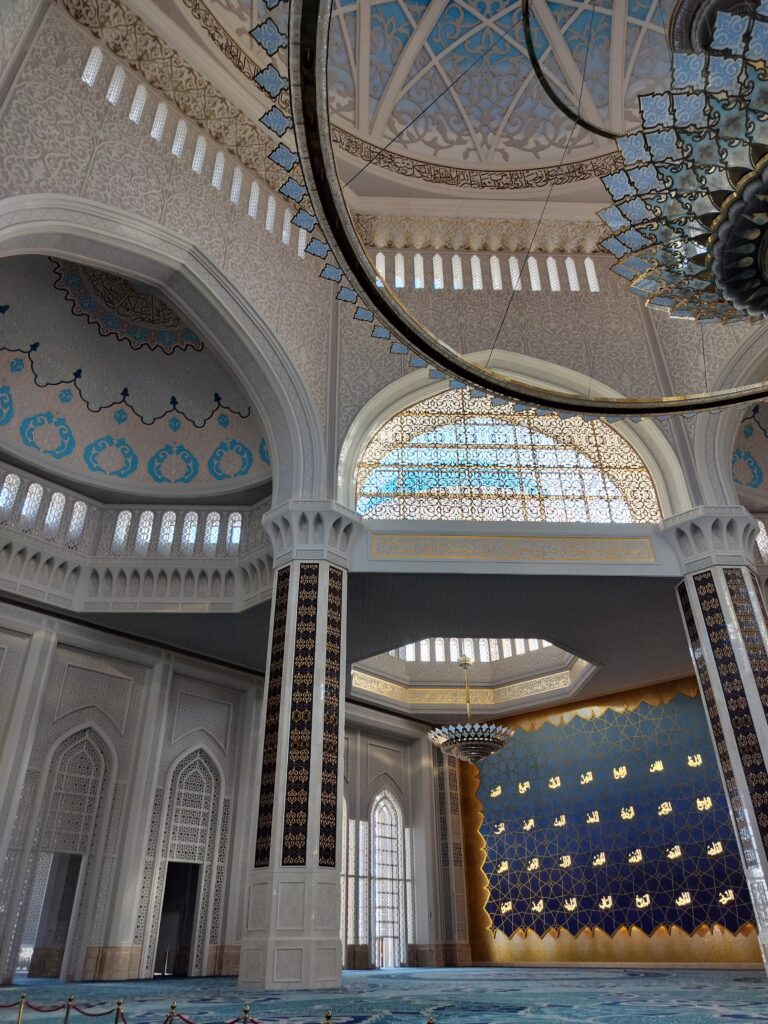
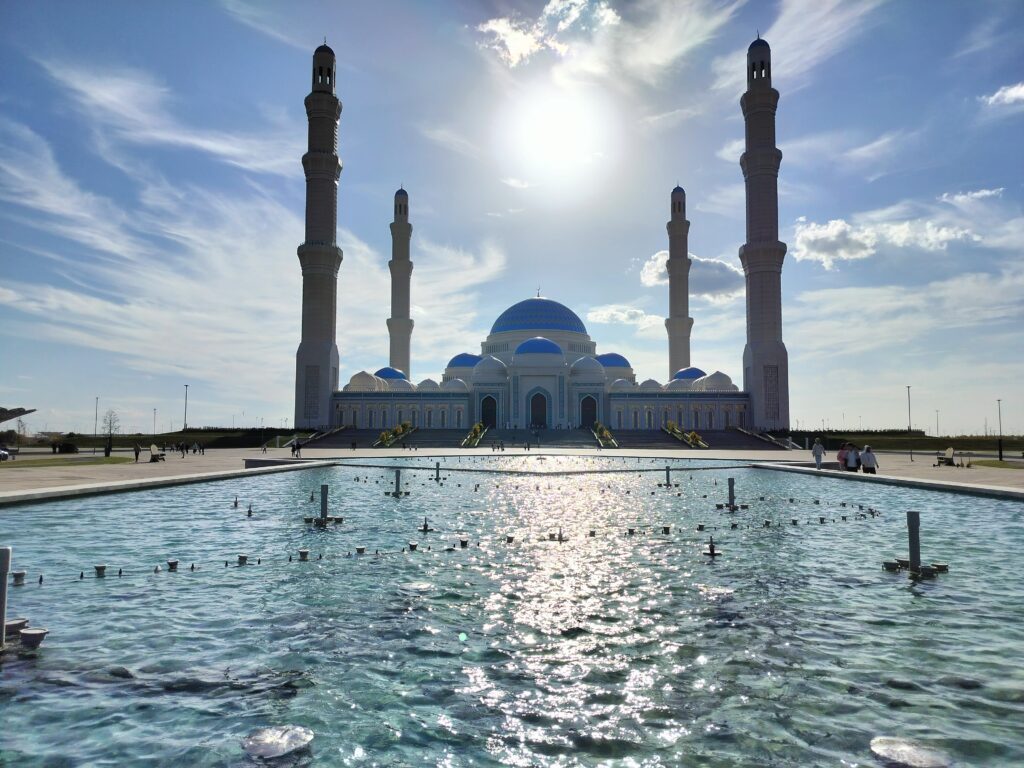
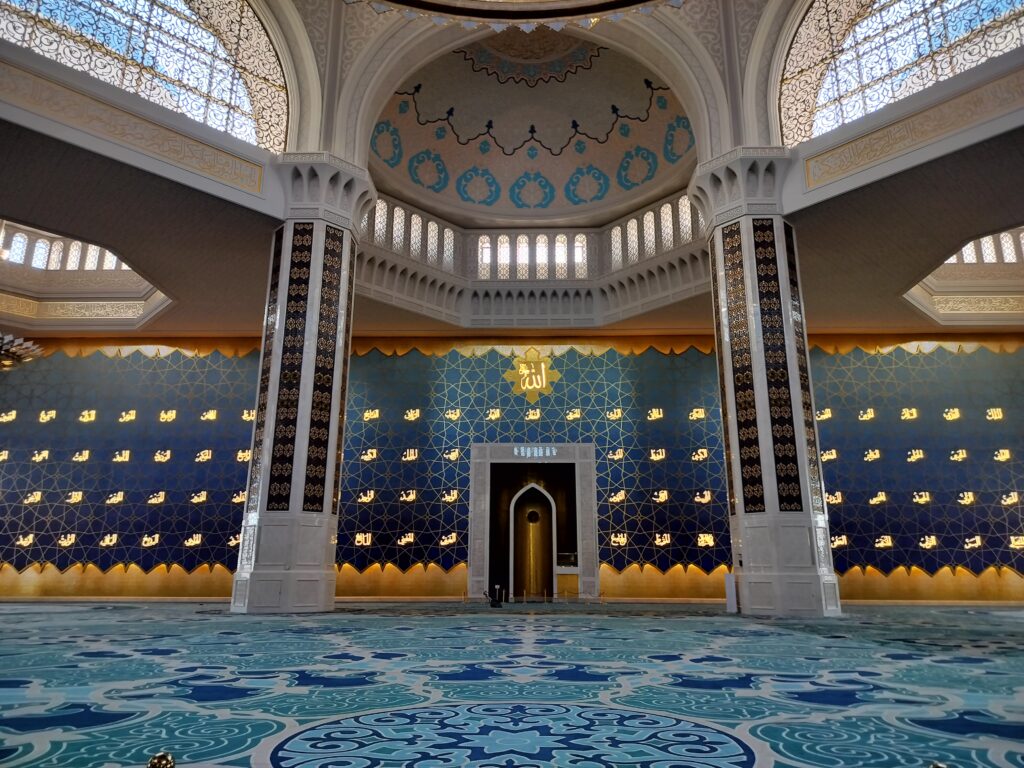
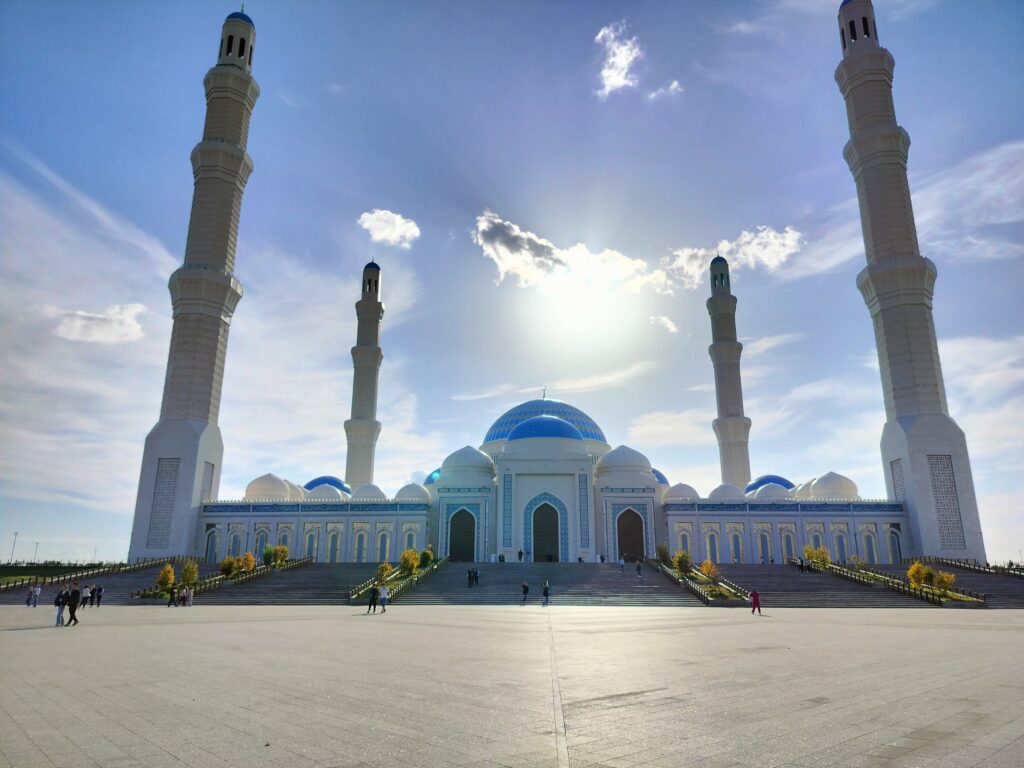
At this point in the day, I have already walked over 11 km, and I am starting to feel tired. However, I still have one last attraction to see before returning to the airport: the Grand Mosque. Since it is far from the other attractions I have already visited, I decide to take a taxi, booked through the ever-reliable Yandex. In virtually all the itineraries I consulted on the web, this mosque is not mentioned at all, which leaves me rather perplexed. It is not only the largest mosque in Central Asia, with a capacity of about 35,000 people, but also a very impressive building, both inside and out, with an architectural mix of traditional and more modern elements. The mosque holds at least three other world records, the first related to the size of the dome, the second to the size of the entrance door, and the last to the size of the handmade carpet that covers the interior floor. Among the interior decorations, the 100-meter mosaic representing the 99 names of Allah, made with approximately 25 million colored glass tiles, is certainly worth mentioning.
My tour of Astana ends at the airport, where I arrive on the last taxi of the day at around 6 p.m., well ahead of my flight departure time to Aktau.
Conclusions
When I started writing this article, I wasn’t sure whether I liked Astana or not. Looking back at the photos, they seem much more beautiful than I remember them being, and they don’t help me give a clear answer to the question.
What I am sure of, however, is that regardless of whether I actually enjoyed it, it was worth visiting at no cost, as I did, i.e., as a necessary stopover on the way to the state’s main attractions. Looking back, I would make the same choice again, partly because I think one day is enough to see more or less everything the city has to offer. To tell the truth, I did like a couple of things very much, in particular the Grand Mosque and the Sultan Hazrat Mosque, both inside and out. The former wins for its interior decorations, the latter for its exterior. The bronze medal goes to the Bayterek Tower, mainly for the context of the park and the singing fountain. I had higher expectations for the Nur Astana Mosque, as it looked much more beautiful in the photos I had found before leaving than it actually is. For the rest, there is a lot of concrete and randomly arranged colors, which make some views look picturesque and others decidedly trashy.
A quick note on costs: the only expense I had to pay for was the taxi, for which I spent a total of around €10, which included all three journeys (airport-city center, Lovers’ Park-Grand Mosque, and Grand Mosque-airport). Admission to the mosques is, of course, free.